Last Updated: May 2026
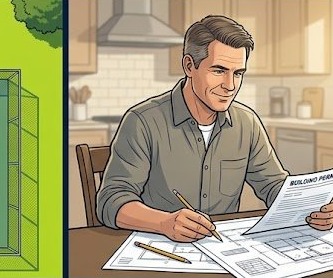
Why Most Backyard Courts Require a Permit
A residential pickleball court is, from a permitting standpoint, a paved accessory structure. Municipalities regulate these for several interconnected reasons: stormwater management (hard surfaces increase runoff), zoning compliance (accessory structures must meet setbacks and coverage limits), and structural safety (a post-tensioned concrete slab requires engineering review in many jurisdictions).
The sport's explosive growth — pickleball is now the fastest-growing sport in the United States for the third consecutive year — has pushed many cities to develop specific policies for residential courts where they previously had none. In jurisdictions that haven't updated their codes yet, courts are generally evaluated under existing accessory structure or paved surface rules, which almost universally require a permit for anything this size.
A standard pickleball court playing area is 30 feet wide by 60 feet long — 1,800 square feet. With recommended safety margins (7 feet on each end, 5 feet on each side), the total paved footprint reaches approximately 44 × 74 feet, or 3,256 square feet. That's a significant addition to any residential lot and almost universally above the threshold for permitless construction in any U.S. city.
What Specifically Triggers a Permit
Most municipalities use a square footage threshold to determine whether a building permit is required for paved surfaces. Common triggers include:
- Over 120–200 square feet of new impervious surface (the threshold varies; some cities use 200 sq ft, others 400 sq ft)
- Any permanent structure attached to the ground (net posts, fencing, lighting poles)
- Any grading or land disturbance above a certain volume (often 50–100 cubic yards)
- Any new electrical work (required for lighting)
- Any drainage modification (French drains, swales, catch basins)
Since a regulation pickleball court with margins is 3,256 square feet — more than 16 times the most common no-permit threshold — virtually every permanent court triggers a building permit.
Types of Permits You May Need
| Permit Type | What It Covers | Typical Fee | Required? |
|---|---|---|---|
| Building Permit | The slab itself — grading, foundation, construction methods | $200–$1,200 | Almost Always |
| Stormwater/Impervious Cover Permit | Managing increased runoff from the new paved surface | $150–$800 | Varies by City |
| Grading Permit | Any earth-moving or land leveling required to create a flat playing surface | $100–$500 | If Site Work Required |
| Electrical Permit | Lighting installation — required whenever new circuits are added | $80–$400 | If Adding Lights |
| Zoning/Use Permit | Confirms the court use is allowed in your zoning district | $50–$300 | Some Jurisdictions |
| Fence Permit | Court perimeter fencing above a certain height (usually 6–8 feet) | $50–$200 | If Court Is Fenced |
When You Might NOT Need a Permit
There are limited circumstances where a pickleball court does not require a permit. These are worth knowing, but they apply to a minority of homeowners:
- Portable tile courts on existing hard surfaces: If you lay interlocking sport tiles on top of an already-permitted concrete driveway or patio, many cities do not require a new permit — the surface already exists. Check whether the color and use trigger any HOA rules, though.
- Portable nets with no permanent anchoring: A portable net set on an existing grass or paved area generally does not require a permit. However, you still cannot violate setback rules, and HOA rules may still apply.
- Very rural or unincorporated areas: Some unincorporated county areas and very rural municipalities have minimal or no permit requirements for residential paved surfaces. This is increasingly rare. Always call your county planning office to confirm.
Even in these cases, it is wise to document that you confirmed no permit was required — a phone call to the building department takes 10 minutes and protects you from fines or forced removal later.
Step-by-Step: How the Permit Process Generally Works
-
Confirm zoning allows the use Call your local planning or zoning department and ask: "Is a residential sport court a permitted use in my zoning district?" Get the answer in writing (email is fine) and ask for the relevant code section number.
-
Calculate your impervious coverage Add up all existing hard surfaces on your lot (driveway, patio, walkways, home footprint) in square feet, then add 3,256 sq ft for the court. Divide by total lot area. Compare to your city's maximum impervious coverage ratio, typically found in your city's zoning code online.
-
Get HOA pre-approval (if applicable) Submit an architectural review request to your HOA board before applying for a building permit. Your HOA's CC&Rs specify the required format and review timeline. See our full HOA approval guide for a step-by-step walkthrough.
-
Prepare permit documents Most building departments require a site plan (showing property lines, existing structures, and proposed court location with dimensions), a construction drawing or specifications sheet, and sometimes a drainage plan. Some cities accept contractor-prepared plans; others require stamped engineering drawings.
-
Submit your building permit application Submit in person or online to your local building department. Pay the permit fee. Processing times for residential projects typically range from 1–6 weeks depending on your municipality.
-
Schedule and pass inspections Most building permits for concrete slabs require at least two inspections: a pre-pour inspection (before concrete is poured, to verify grading and formwork) and a final inspection. Ask your permit office what is required before your contractor starts work.
What Happens If You Build Without a Permit
Building without a required permit exposes you to several serious risks that make the short-term time savings not worth it:
- Stop-work orders: Your city can issue an order to halt all work immediately until a permit is obtained.
- Fines: Permit violation fines typically range from $200 to $5,000 per violation and can be assessed daily.
- Retroactive permit fees: Most cities charge double or triple the normal permit fee when a permit is pulled retroactively.
- Forced removal: In serious cases, a building official can require you to demolish an unpermitted structure at your expense.
- Home sale complications: Unpermitted improvements must typically be disclosed at sale, and buyers' lenders may require remediation before closing.
- Insurance denial: Homeowners insurance may deny claims for damage related to an unpermitted structure.
State-Specific Permit Guides
Permit requirements vary significantly from state to state and even city to city. For detailed information specific to your location, see our state guides:
🌴 California
Impervious coverage rules are strict. Many cities require a Conditional Use Permit.
⭐ Texas
Harris County and many Texas cities require non-structure permits for impervious cover additions.
☀️ Florida
Stormwater management is a primary concern. Most Florida counties have strict coverage limits.
🌵 Arizona
Desert cities have impervious surface rules tied to water management. HOA rules are prevalent.
🏔️ Colorado
Front Range cities have active noise ordinance development for pickleball courts.
🍑 Georgia
Many Atlanta-area counties require permits and HOA approval for sport courts.